Ultrafast spectroscopy
Femtosecond pump-probe and multidimensional methods, resolving electronic and vibrational dynamics as they happen.
PhD candidate · Graduate Research Assistant · Deep Spectroscopy Lab, Michigan State University
I use femtosecond laser to read what happens to a single particle while an electrochemical potential pushes charge in and out of it — the dynamics that ensemble measurements average away.
A simulated reversible one-electron voltammogram drives the panels: injected charge shifts and damps the plasmon resonance and stiffens the acoustic modes. Simulation — not measured data.
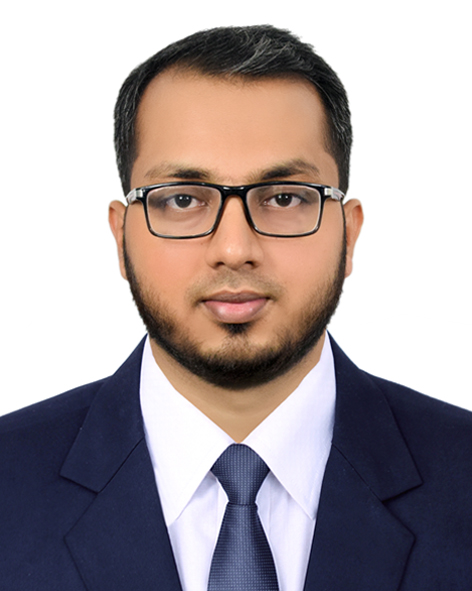
I'm a PhD candidate in the Department of Chemistry at Michigan State University, working with Dr. Elad Harel in the Deep Spectroscopy Lab. My project applies ultrafast spectroscopy to nano- and quantum materials held under an electrochemical gradient, so that structural and electronic dynamics can be followed on a single particle rather than inferred from a population average.
Before MSU I spent four years building energy-storage materials in Bangladesh — first as a research assistant and then as a research fellow at BUET, where I developed crushed 3D-graphene / manganese-oxide composites for supercapacitors and hard-carbon anodes from cotton and jute waste for Na/K-ion battery prototypes. A later fellowship at BCSIR took the same nanomaterials work into food science: green synthesis, antibacterial activity, and preservation and packaging.
The thread running through all of it is the same question in different clothes: how does structure at the nanoscale set what a material can do — store charge, catalyse, sense, convert energy — and what tools let us see that directly. I'm proficient across XRD, FESEM, EDX, TEM, XPS, Raman, FTIR and the full electrochemical toolkit, and I analyse in MATLAB and OriginLab.
I've authored or co-authored 26 peer-reviewed journal articles alongside 18 conference papers and presentations, cited around 700 times to date. I also teach — general chemistry laboratory at MSU, and previously at BUET and Dhaka City College.
Femtosecond pump-probe and multidimensional methods, resolving electronic and vibrational dynamics as they happen.
Optical readout of one particle under applied potential, instead of averaging over a heterogeneous ensemble.
Low-dimensional and correlated systems, and the coherent behaviour that emerges from their structure.
Design and fabrication of nano-space-architected functional materials with controlled size and morphology.
The fundamental physical and chemical principles underlying how these materials behave.
Synthesis, characterisation and structure-property relationships across composite and hybrid systems.
Voltammetry, impedance and galvanostatic methods, from bulk three-electrode cells down to single particles.
Supported nanocatalysts and modified electrodes for reduction chemistry and electrochemical detection.
Supercapacitor and battery electrodes: graphene-metal-oxide composites, biomass carbons, Zn-ion cathodes.
Doctoral project. Applying femtosecond and multidimensional optical methods to single particles while an electrochemical potential drives charge in and out — resolving dynamics that ensemble measurements average away, and connecting optical response directly to redox state.
MATLAB toolchain that turns wavelength-scan image stacks into per-particle spectra: particle identification, background handling, spectral extraction and batch processing across scans.
Converted cotton and jute waste into hard-carbon anodes and cellulose-based gel membranes, then built and characterised half and full cells. Investigated ion storage and the exchange mechanism across a polyelectrolytic cellulose gel separator, with the goal of a genuinely low-cost next-generation storage chemistry.
My MSc work and the thread that followed it. Metal and metal-oxide templating produces a crushed three-dimensional graphene scaffold; decorating it with manganese oxide nanorods lifts capacitive performance well above either component. The core result was establishing which morphological features actually drive the gain.
Vehicle exhaust soot as a feedstock for supercapacitor electrodes. Pyrolytic activation yields mesoporous carbon that is heteroatom self-doped by its own origin — no separate doping step — with long cycle life and high specific capacitance.
Carrying the crushed-graphene / manganese-oxide architecture over from capacitive storage into aqueous Zn-ion intercalation chemistry, where the same conductive scaffold has to survive repeated Zn insertion.
Polyampholyte hydrogels as a model system for self-healing: relating healing efficiency to supramolecular gel structure, and measuring heavy-metal-ion uptake by cyclic voltammetry to model the sorption kinetics.
Green-synthesised nanomaterials applied to antibacterial activity, preservation and packaging — alongside formulation work developing high-nutrient foods from cheap, locally available ingredients.
Deep Spectroscopy Lab (The Harel Group), Department of Chemistry, Michigan State University · Advisor: Dr. Elad Harel
Department of Chemistry, Michigan State University · CEM 161 and CEM 162 General Chemistry Laboratory · four semesters
Institute of Food Science and Technology, BCSIR, Dhaka · Quality Control Division · Supervisor: Dr. Tasnim Farzana
Department of Chemistry, BUET · "A novel biomass-derived Na/K-ion battery prototype" · Funded by EPRC, Bangladesh · PI: Dr. Al-Nakib Chowdhury
Department of Chemistry, BUET · "Green adhesives from supramolecular dynamic bonds of polymers" · Ministry of Education project · PI: Dr. Chanchal Kumar Roy
Department of Chemistry, Dhaka City College, Dhaka
Department of Chemistry, BUET · 3D-graphene rGO–MnOx composites for electrochemical capacitors · PI: Dr. Shakhawat Hossain Firoz
Department of Chemistry, BUET, Dhaka
Michigan State University, East Lansing, Michigan · Physical chemistry & materials chemistry · Advisor: Dr. Elad Harel
Bangladesh University of Engineering and Technology (BUET), Dhaka · Physical-inorganic chemistry · Thesis: Influence of metal (Ni) and metal oxides (iron oxide) on the electrochemical capacitance of rGO–MnOx nanocomposites · Advisor: Dr. Md. Shakhawat Hossain Firoz · Ranked 1st of 17
Comilla University, Cumilla, Bangladesh · Ranked 5th of 33
Outstanding Teaching Assistance Award — Department of Chemistry, Michigan State University
Academic Excellence Award — Department of Chemistry, BUET, Dhaka
Forum 86 Research Excellence Award — Forum 86, BUET, Dhaka
Research Intensive Award — BUET, Dhaka
Research Intensive Award — BUET, Dhaka